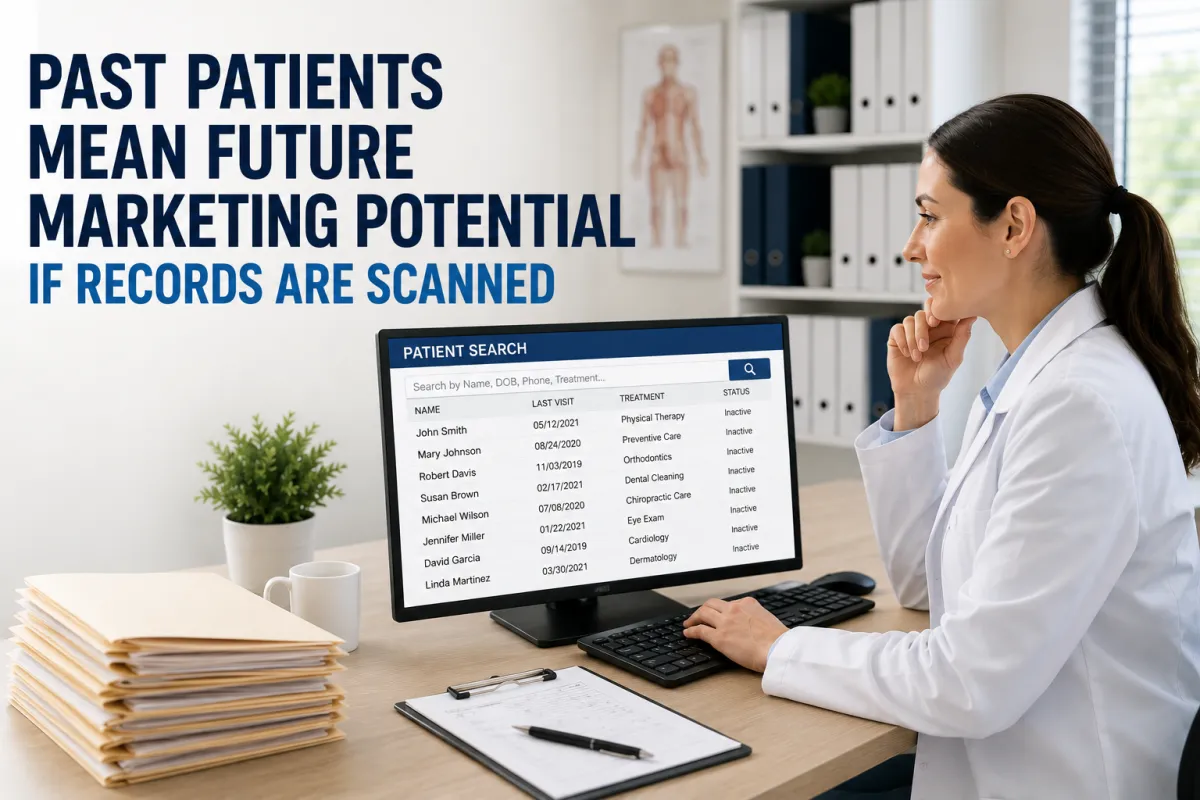
Past Patients Mean Future Marketing Potential — If Records Are Digitized
Healthcare, Medical Records, Digital Conversion
Paper Charts Often Contain Valuable Business Opportunities
For many medical practices, old patient charts are viewed simply as storage problems.
Rows of filing cabinets, boxed archives, and off-site storage often contain years—or decades—of inactive records taking up valuable space.
But many practices overlook an important reality:
Past patient records may also represent future business opportunities and a chance to deliver more proactive, continuous care.
When these records are organized and accessible, they can support better patient outcomes and sustainable practice growth.
Your Existing Patient Database Is Extremely Valuable
Most healthcare providers spend significant money trying to attract new patients through:
Advertising
SEO
Social media
Referral campaigns
Direct mail marketing
💡 Pro Tip: New patient acquisition is important, but nurturing relationships with former and inactive patients is often more cost-effective and can quickly improve revenue stability.
Meanwhile, many already possess thousands of former patient records that may include individuals eligible for:
Follow-up treatments
Annual exams
Preventive care
Updated procedures
New services
Long-term care programs
The challenge is accessibility.
Paper Charts Make Patient Outreach Difficult
When records remain stored in paper format, practices often struggle to:
Search patient histories efficiently
Identify eligible patients
Sort records by treatment type
Locate inactive patient groups
Build targeted outreach campaigns
Manually reviewing paper charts becomes time-consuming and impractical.
📌 Key Takeaway: If your staff has to dig through boxes or filing cabinets to find the right patients, outreach efforts will stall—and valuable care opportunities may be missed.
Digitized Records Create Searchable Opportunities
Professionally scanned and OCR-searchable records help practices organize information in ways that are far more usable operationally.
Digitized systems can help practices:
Locate records faster
Improve internal workflows
Reduce retrieval delays
Organize archived charts
Build more structured patient databases
Having organized digital files creates a stronger foundation for operational efficiency and future patient communication strategies.
💡 Pro Tip: With searchable, well-indexed digital records, your team can quickly build lists of patients who may benefit from recalls, screenings, or new treatment options—without adding administrative burden.
Better Organization Supports Better Growth
Medical offices that modernize records often gain more than storage space.
They also improve:
Staff productivity
Accessibility of records
Response times
Long-term archive management
Operational scalability
In many cases, digitization becomes part of a broader modernization strategy for growing practices.
Thoughtful records management supports not only compliance and security, but also a more responsive, patient-centered experience.
Helping Medical Offices Go Digital
At USA IMAGING, Inc., we help healthcare providers convert paper patient charts into organized, searchable digital files designed for efficiency, accessibility, and long-term record management.
Because old records may still hold future value—if your practice can access them efficiently.
📌 Key Takeaway: Partnering with a trusted, HIPAA-aware scanning provider like USA IMAGING, Inc. helps you protect patient confidentiality while unlocking the full potential of your archived charts.
Ready to explore how digitizing your paper charts can support both patient care and practice growth? Get a quote from USA IMAGING, Inc. and take the next step toward a more organized, efficient, and secure records environment.


