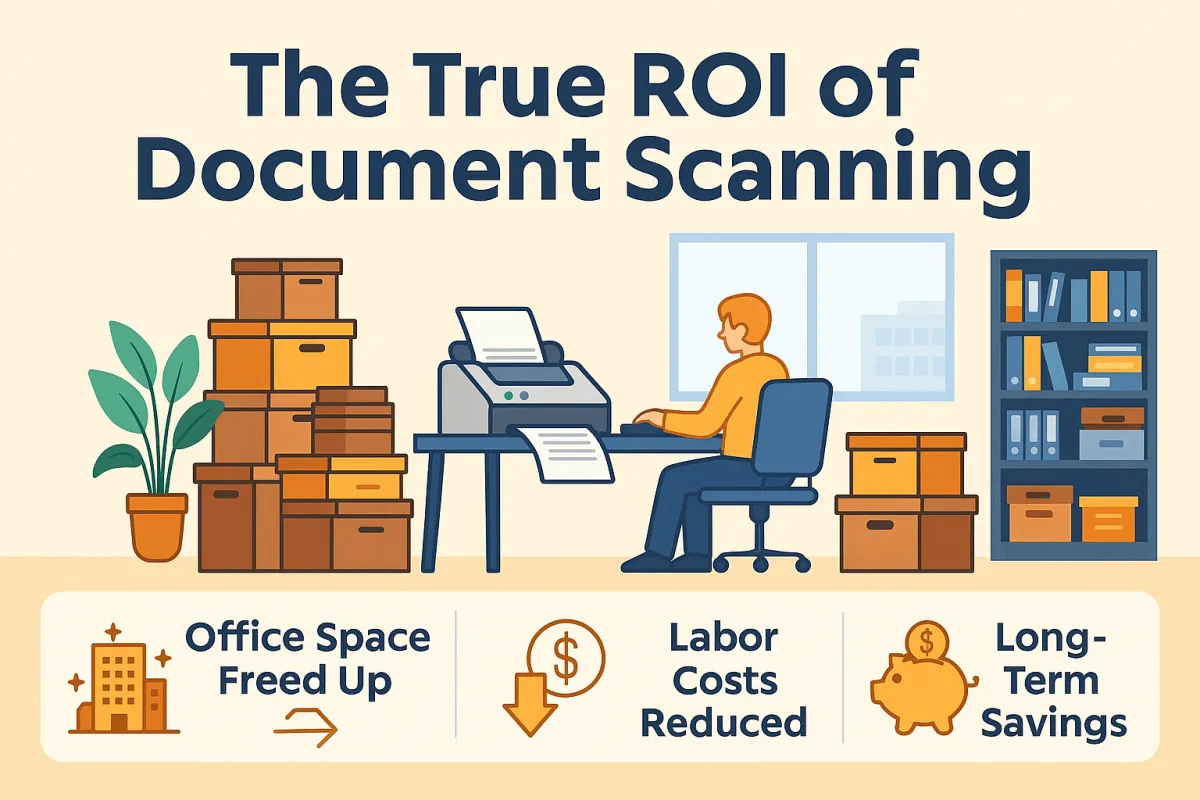
The True ROI of Document Scanning
By USA IMAGING, Inc.
Paper records may seem inexpensive to maintain, but the real cost goes far beyond filing cabinets and storage boxes. Employee time, document retrieval, physical storage, administrative handling, and misplaced records can create ongoing expenses for businesses of every size.
For companies throughout San Diego County, document scanning offers a practical way to reduce these costs while making business records easier to find, organize, and manage.
But how much can a business actually save?
Let's examine the real return on investment (ROI) of converting paper documents into searchable digital files, using realistic examples rather than inflated industry statistics.
1. The Hidden Cost of Paper Document Storage
Every filing cabinet, storage room, and offsite storage box occupies space that could potentially serve another business purpose.
For San Diego businesses operating in Poway, Sorrento Valley, Carlsbad, Escondido, and surrounding communities, office space is a valuable resource.
Consider a business dedicating 100 square feet to paper records.
Annual space cost | Value of 100 sq. ft. |
|---|---|
$30 per sq. ft. | $3,000 |
$40 per sq. ft. | $4,000 |
$50 per sq. ft. | $5,000 |
These are illustrative cost scenarios, not verified San Diego market rental rates.
Document scanning can help businesses reclaim space for workstations, equipment, or other operational needs.
The financial benefit depends on whether the business can eliminate storage expenses, reduce leased space, or put the recovered area to more productive use.
2. Employee Document Retrieval Costs Add Up
One of the most overlooked expenses of paper recordkeeping is the time employees spend locating information.
Searching through filing cabinets, retrieving archived boxes, and manually reviewing documents can interrupt normal operations.
Consider this example:
Employee hourly cost: $30
Time spent retrieving paper records: 30 minutes per workday
Working days per year: 250
Annual retrieval time: 125 hours
Estimated annual labor cost: $3,750 per employee.
For five employees with similar document retrieval needs, that represents $18,750 in annual labor time.
These figures are illustrative, and not all retrieval time can necessarily be eliminated.
However, converting paper records into OCR-searchable PDF files allows employees to locate information using keywords, document names, dates, and indexed folders.
Instead of searching through physical files, employees can retrieve digital records through their organization's authorized file-storage system.
3. Reduce Recurring Paper Management Expenses
Maintaining physical records involves more than purchasing filing cabinets.
Businesses may incur recurring expenses associated with:
Offsite document storage and retrieval fees
Physical filing supplies and replacement folders
Staff time spent retrieving, organizing, and refiling documents
Transportation of archived records between facilities
Administrative preparation for audits and legal requests
Document digitization can reduce many of these ongoing expenses.
For organizations with established records retention requirements, digital conversion also makes it easier to distinguish documents that must remain in physical storage from those eligible for authorized destruction.
Important: Scanning does not automatically eliminate legal or regulatory requirements to retain original documents. Businesses should follow their applicable retention policies before authorizing disposal.
4. What Does Document Scanning Actually Cost?
The initial cost of scanning depends on the volume, condition, organization, and required output of the records.
At USA IMAGING, Inc., standard document scanning projects can be priced by the box, making it easier for businesses to estimate the cost of converting archived records.
For illustration, using a standard scanning rate of $140 per box:
Number of boxes | Estimated scanning cost |
|---|---|
10 boxes | $1,400 |
25 boxes | $3,500 |
50 boxes | $7,000 |
100 boxes | $14,000 |
Illustrative pricing for standard document boxes. Actual quotes depend on project requirements, document condition, indexing, and any additional services.
A properly planned scanning project may include document preparation, high-resolution scanning, optical character recognition (OCR), quality control, and organized digital delivery.
The goal is not simply to create digital images. It is to produce usable electronic records that support daily business operations.
5. Calculating Your Document Scanning ROI
Return on investment compares the financial benefit of digitization with its initial cost.
ROI (%) = (Financial Benefits − Scanning Cost) ÷ Scanning Cost × 100
Consider a hypothetical San Diego business converting 25 boxes of archived records.
Initial scanning investment: $3,500
Estimated annual benefits:
Potential annual benefit | Estimated value |
|---|---|
Reduced employee retrieval time | $3,000 |
Eliminated offsite storage fees | $1,200 |
Reduced administrative handling | $800 |
Total estimated annual benefit | $5,000 |
Using these assumptions:
Initial investment: $3,500
First-year benefits: $5,000
First-year net benefit: $1,500
Estimated first-year ROI: 42.9%
Estimated payback period: 8.4 months
These figures are hypothetical and assume the projected benefits are actually realized. They exclude any ongoing digital storage or software costs.
Actual ROI varies depending on document volume, employee workflows, existing storage expenses, and how frequently records are accessed.
6. Why Searchable PDFs and Document Indexing Matter
Scanning documents is only the first step. How those files are organized determines how useful they become.
At USA IMAGING, Inc., digital conversion projects can include:
OCR-Searchable PDFs
Optical character recognition converts printed text within scanned images into searchable content, making it easier to locate information without manually reviewing every page. OCR accuracy varies with the quality and condition of the originals.
Document and Folder Indexing
Files can be organized according to existing folder names, customer identifiers, project numbers, dates, or other agreed-upon naming conventions.
Quality Control
Digital files are reviewed for image quality, completeness, orientation, and readability according to the project's specifications.
Secure Electronic Delivery
Completed files can be delivered through an authorized digital repository or physical USB media, depending on project requirements.
Together, these services help turn paper archives into organized digital records.
7. Benefits Beyond Immediate Cost Savings
Not every benefit of document scanning can be measured in dollars.
For many organizations, the operational advantages are equally important.
Faster audit preparation: Organized digital records make it easier to assemble documentation for internal reviews, financial audits, and regulatory requests.
Business continuity: Digital copies maintained within an appropriately backed-up system can reduce dependence on a single physical archive.
Controlled access: Businesses can use their own document-management systems to establish access permissions and authorized sharing.
Reduced physical handling: Frequently requested documents can be reviewed electronically rather than repeatedly retrieved from storage.
Long-term organization: Consistent file naming and indexing make growing digital archives easier to manage.
These benefits are particularly relevant to healthcare organizations, biotechnology companies, legal offices, accounting departments, construction firms, and local government agencies.
8. When Is Document Scanning Worth the Investment?
Document scanning is especially valuable when a business:
Maintains multiple boxes of archived records
Frequently retrieves historical documents
Pays recurring offsite storage charges
Needs organized records for audits or compliance reviews
Is relocating, downsizing, or reorganizing office space
Wants to reduce reliance on physical filing systems
The greatest value often comes from combining one-time document conversion with a long-term digital records management strategy.
Document Scanning Services Throughout San Diego County
USA IMAGING, Inc. provides document scanning and digital conversion services from our Poway facility, serving businesses throughout San Diego County, including San Diego, Carlsbad, Oceanside, Escondido, Vista, San Marcos, Rancho Bernardo, Sorrento Valley, and surrounding communities.
Our services include bulk document scanning, OCR-searchable PDFs, folder-level indexing, large-format scanning, quality control, and secure digital delivery.
Whether your organization has a small archive or hundreds of document boxes, we can help evaluate the scope of the project and develop a scanning solution based on your records and operational needs.
Find Out What Document Scanning Could Save Your Business
The true ROI of document scanning is not simply the cost of converting paper into PDFs.
It is the long-term value of faster document access, reduced physical storage, improved organization, and more efficient business operations.
USA IMAGING, Inc. helps San Diego businesses turn paper archives into accessible, searchable digital records.
Request a Document Scanning Quote to discuss your project and explore the potential benefits of digitization.


